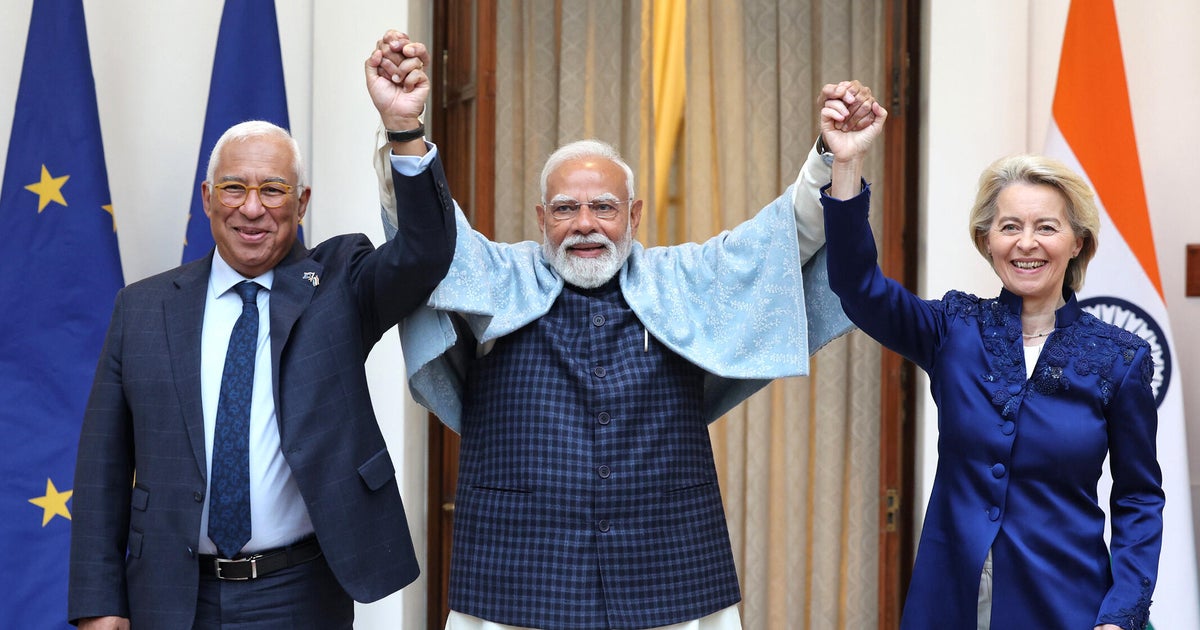
The European Union and India announced a landmark Free Trade Agreement on Tuesday. The two economies, which together represent about a quarter of the world’s population, have spent nearly two decades arguing over the terms of the deal.
So what brought them together to ink what the EU has hailed as “the mother of all treaties”?
Statements by European leaders suggest that the self-proclaimed deal kingpin, President Trump, and his tariff-based trade policy over the past year, may have helped push the two sides toward a final deal.
And they are not alone.
Many of the world’s major economies have rushed to forge new bilateral agreements as doing business with the US has become suddenly, and in many cases surprisingly, expensive and unpredictable.
India and EU sign “mother of all agreements”
Indian Prime Minister Narendra Modi called the trade deal with the EU “historic,” saying it would “deepen economic ties, create new opportunities … and strengthen ties” between “the world’s largest democracies.”
Press Information Bureau (PIB)/Anadolu/Getty
He said it would “make access to European markets easier for Indian farmers and small businesses” and boost his country’s manufacturing and services industries.
The agreement will see prices reduced on a variety of products, including textiles, clothing, leather, footwear, gems and jewellery, handicrafts, engineering goods and automobiles. India will also reduce tariffs on wine, beer and olive oil imported from the EU. Both economies will gain unprecedented, exclusive market access to each other’s products, their leaders said on Tuesday.
Europe’s major auto industry, for example, will see India’s current tariffs on imported cars slashed from a high of 110% to 10%.
“We did it, we brought the mother of all agreements,” European Commission President Ursula von der Leyen said at a ceremony announcing the agreement in New Delhi.
The free trade agreement, which will be officially signed later this year after it is approved by the European Parliament and the bloc’s member states, will allow free trade in goods between India and the 27 EU countries.
Together, India and the EU account for 25% of the world’s GDP and a third of global trade, according to an Indian government statement. The EU is already one of India’s largest economic partners, with bilateral trade worth around $137 billion by 2024-25. In comparison, US-India bilateral trade during that period totaled approximately $132 billion.
Separately, India and the EU also agreed on a travel framework that will ease restrictions on the movement and work of skilled professionals.
UK looks to China for “order and organization” amid Trump’s “disruption”?
British Prime Minister Keir Starmer arrived in China on Tuesday, starting the first visit by a UK leader to the country since 2018.
“For years, our approach to China has been governed by inconsistencies – breathing heat and cold, from the Golden Age to the Ice Age. But like it or not, China is important to the UK As one of the world’s major economic players, a strategic and consistent relationship with them is strongly in our national interests,” said Starmer in a statement before leaving Beijing. “That doesn’t mean we don’t ignore the challenges they face – but to engage even when we don’t see eye to eye. This is what our partners do, and what I will do: bring the community, put more money in their pockets and keep them safe through strong cooperation, and consistent cooperation abroad.”
Carl Court/POOL/AFP/Getty 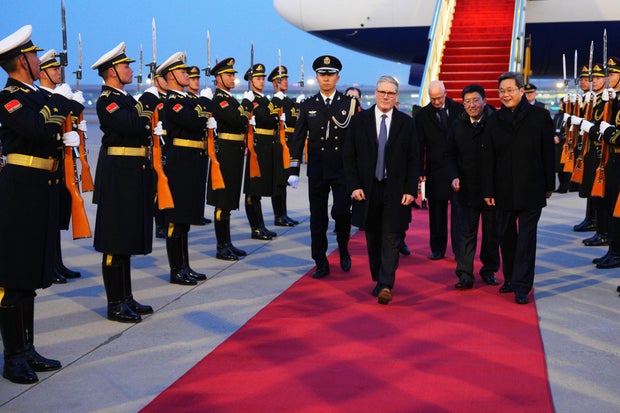
Starmer, who was accompanied by a delegation of leading UK businesses including HSBC and Jaguar Land Rover, was expected to meet President Xi Jinping and Premier Li Qiang to discuss “trade, investment and national security,” according to a British government statement.
“At a time of growing instability around the world, when events abroad continue to affect people at home, the Prime Minister has promised to do what the UK wants,” the government said.
Dr. Yu Jie, a senior researcher on China at Chatham House, told the CBS News partner network BBC News that China also has incentives to build closer relations with the UK, which it may see as an investment destination that can bring “order and order” amid the “disruption” caused by President Trump’s foreign policy.
Canada-China trade agreement
Earlier this month, Canadian Prime Minister Mark Carney visited Beijing, becoming the first Canadian leader to visit China in nearly ten years.
Carney and Chinese President Xi Jinping announced a tit-for-tat tariff reduction agreement between the two countries on items such as canola oil and electric vehicles.
Xi hailed the deal as a “turning point” in relations between China and Canada, the latter of which has sought to diversify its trade relationship.
Xie Huanchi/Xinhua/Getty 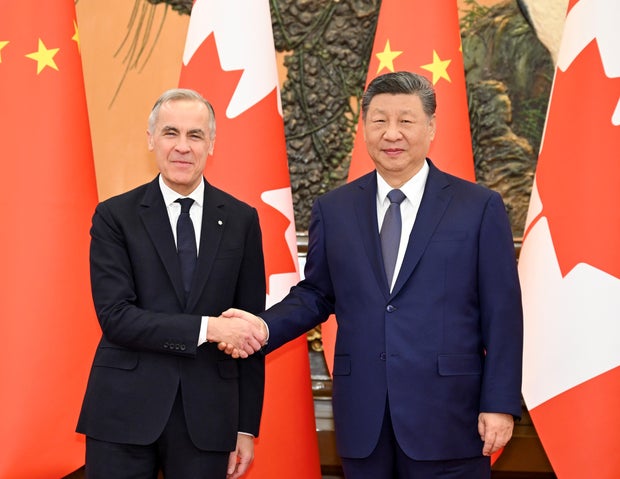
Canada’s largest trading partner is the United States, but that relationship is under increasing pressure due to President Trump’s inconsistent tariff policy. It was an issue Carney addressed during his visit, when asked if China is a more predictable and reliable partner for Canada than the United States.
“One comparison I’ll give you with the United States, our relationship … is much more, much deeper, much broader than with China,” Carney said. “But yes, based on how our relationship has developed in recent months with China, you can guess, and you see results coming from that.”
President Trump responded to the agreement by threatening to impose 100% tariffs. on Canadian importation to the US if completed.
“If Canada makes an agreement with China, it will immediately be subject to a 100% Tariff on all Canadian goods and products entering the USA,” he said on his Truth Social blog.
Are Trump’s tariffs fueling China’s trade growth?
The push for bilateral deals comes as President Trump puts more pressure on many of America’s longtime allies and partners, both economically and politically. Some analysts think the pressure is benefiting one of America’s biggest enemies.
“Many countries that previously were not friendly with China are now willing to go to China … because the United States is becoming less and less visible,” Aleksandar Tomic, an economics professor at Boston College, told Reuters news agency. “The harder the US gets to deal with, the more it opens up to China.”
“I think China has done a good job and should position itself as a reliable and stable trading partner,” Derrick Irwin, head of emerging market equities at Allspring Global Investments, told Reuters. “They basically said, look, you have a major trading partner in the US that is becoming more uncertain. We can provide predictability and certainty. And I think that’s very fair.”
Some experts have also warned that growing mistrust in the US does not mean that China will become a reliable economic partner.
“Many of these countries have deep concerns about China’s approach to trade, its use of economic pressure, and unresolved historical and maritime disputes,” Patricia Kim, a foreign policy fellow at the Washington-based Brookings Institution, told Reuters. “At the moment, China may seem restrained or prudent compared to the Trump administration’s extreme rhetoric and actions. But Beijing’s actual behavior has not particularly reassured it.”
“Strong message,” but is the US missing out?
Mr. Trump slapped India with 50% tariffs last year – part of which was imposed to punish India for keeping its oil from Russia – amid heated negotiations over a bilateral trade deal. The US and India have said they are close to finalizing a deal, but given the dispute over India’s energy purchases from Russia, no dates have been set.
“I think of them [India and U.S.] they’re actually very close to the scenes,” Mark Linscott, a trade policy expert and senior adviser at the US India Strategic Partnership Forum, told CBS News. “I think a few compromises on both sides will get them to an agreement.”
Mr. Trump also imposed higher tariffs on European exports, however he quickly retreated from the risk of hitting the bloc with high prices even amid the disagreement over Greenland.
European leaders were keen to point out that the free trade deal with India shows the bloc is open for business – with issues loosely covered in Mr Trump’s proceedings.
Without mentioning the American leader by name, European Council President António Costa said the bilateral agreement with India sent “an important political message to the world, that India and the EU believe more in trade agreements than in fruits.”
Von der Leyen called the agreement “a strong message that cooperation is the best answer to global challenges.”
In the past seven months, India has also signed major trade agreements with the UK, Oman and New Zealand. The EU has also struck a deal with the South American bloc Mercosur, following deals last year with Indonesia, Mexico and Switzerland.
But although the goals of Mr. Trump may push other countries to make agreements beyond Washington, Linscott, who was the US trade negotiator during Mr. Trump’s administration, said that America was not left out.
“If you look at the last 12 months, the country that has completed the largest number of trade agreements is the United States. There are many countries around the world that still want to do deals with the US,” he said.
He told CBS News that recent trade deals may have focused on efforts to “separate trade and security chains” in the wake of the COVID-19 pandemic, when “it becomes clear how vulnerable those are.”