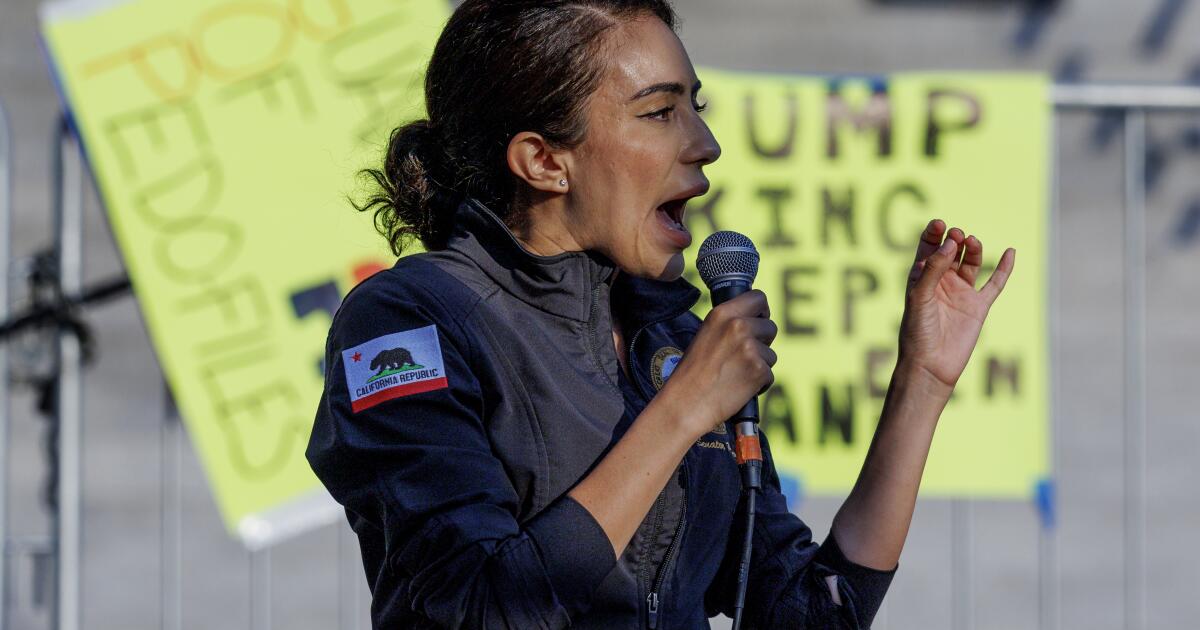
California state Sen. Sasha Renee Perez (D-Pasadena) announced Friday new legislation that would impose fines and suspend or revoke licenses at immigration detention centers when they fail to meet minimum health and safety standards.
The proposed legislation — SB 995 — aims to help federal authorities ensure that private detention facilities comply with federal health and safety standards through inspections.
Detention facility operators will be required to correct any deficiencies identified by inspectors or face a civil penalty of up to $25,000 per day for each violation. Users may also risk having their government-issued licenses suspended or revoked.
“Private detention centers have received millions in profits and continued to secure contracts with government agencies, despite documented health and safety violations,” Perez said in a written statement. “It’s time for the State of California to exercise its legal and ethical authority to scrutinize private detention facilities, hold bad actors accountable and close facilities with consistent, documented human rights abuses.”
In a report released last yearCalifornia Atty. Gen. Rob Bonta reviewed the state’s six private immigration detention facilities and found major deficiencies, including inadequate health and mental health care, inadequate suicide prevention policies, a lack of transparency about use-of-force procedures, and violations of due process including access to legal counsel.
Perez and immigrant rights groups say the problems have persisted, if not worsened, despite federal inspections conducted under Immigration and Customs Enforcement standards.
There are at least six immigration detention facilities in California, some of which have been closed but reopened to accommodate the increase in immigration detention as President Trump deports more people.
A spokesperson for the Department of Homeland Security could not be reached for comment.
There are currently 68,289 immigrants in detention centers across the US and at least 74% of the inmates do not have criminal convictions, according to TRAC, a data research organization.
Many of those charged are for minor offenses, including traffic violations.
Earlier this year, the US Department of Homeland Security said about 70% of the population those the agency arrested have been convicted or charged with a crime in the United States.
In the first nine months of immigration violations, from Jan. 1 through October 15, a Times analysis of ICE arrests across the country found that percentage to be roughly the same.
In Los Angeles, a similar analysis found that of more than 10,000 Los Angeles residents who were arrested on immigration charges, approximately 45% were charged with a crime and an additional 14% had pending charges.
Friday’s announcement comes as the Trump administration looks to expand the number of detention centers across the country.
But what is weighing on the administration is the growing number of immigrants who die in the custody of federal immigration authorities.
Last year, 33 people died while in ICE custody, according to reports of deaths of detainees published by the Department of Homeland Security. Other deaths occurred at facilities in California.
SB 995 is named for Masuma Khan, an immigrant from Bangladesh and survivor of the Eaton fire who was incarcerated in October 2025 at the California City Detention Facility, a former prison in the Mojave desert, about 67 miles east of Bakersfield.
The facility was the subject of a lawsuit filed by seven immigrants who alleged brutal conditions and mistreatment.
Last month, a federal judge ruled in the case, ordering ICE and Homeland Security to provide “constitutionally adequate health care” to people detained at the facility. He also needed an outside watchdog to ensure compliance.
Ryan Gustin, a spokesman for CoreCivic, which runs the center, told The Times that “they are working closely with our partners in government to ensure that we are providing all the necessary services and meeting the applicable standards.”
Khan said he was kept in cold conditions, often without warm clothes, proper food or access to essential medicines. In November, a judge ordered Khan’s release and stayed his arrest until the court considers the government’s argument as to why he should be detained.
“Masuma Khan represents just one of the many people who have no criminal record, who demonstrate commitment to being appointed to government, and who are still being targeted by the Trump Administration,” Perez said in a statement.
“No one in California should lose their dignity, their well-being, or their health because an institution failed to meet basic health and safety standards,” said Hector O. Villagra of the Mexican American Legal Defense and Education Fund (MALDEF), which is co-sponsoring the bill. “California has the right and responsibility to ensure that all planned housing facilities meet basic standards of safety, sanitation, and humane management.”
Angelica Salas, the executive director of the coalition for Humane Immigrant Rights (CHIRLA), which also sponsored the bill, said the state must use its administrative powers to ensure that citizens in detention centers receive basic services, care and safety.
“It is sad to continue to use these facilities without supervision given the unprecedented number of people incarcerated in our province,” he said.
Perez said the bill, called the Masuma Khan Justice Act, will begin the legislative process in the coming weeks.