Amid the series of oil price hikes, the country has a fleet of locally made electric vehicles (EV) that can serve as a viable alternative for passengers and transport operators, according to the Department of Science and Technology (DOST) on Thursday.
“We have made smart, long-term investments in the Philippines’ e-mobility research,” Renato U. Solidum Jr., DOST Secretary, said in a statement.
“With the continued increase in fuel prices around the world, this technology offers Filipinos a real, practical way to save on costs while contributing to cleaner communities.”
DOST has identified six new EV models with high potential for widespread adoption in the country.
Among these is the M/B Dalaray, the country’s first designed and built battery-electric boat, which was first launched in October.
It crosses the Pasig River, allowing passengers to reach major urban areas in the capital in a clean and sustainable manner.
The DOST previously said the boat runs on lithium-ion batteries and can travel for about 45 kilometers, or two to three hours of operation.
IM/B Dalaray operates daily from Monday to Saturday. It departs at 1:30 pm from Guadalupe to Escolta station, and at 3:00 pm from Escolta back to Guadalupe.
Another Filipino-made EV innovation is the C-Trike, an electric version of a tricycle.
It uses 4.5 kilowatts of energy for a 56.4 kilometer trip, DOST said, noting its mileage efficiency.
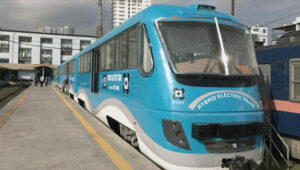
On the railway side, DOST has also developed the Hybrid Electric Train (HET), a 20-meter long coach-driven system that uses both diesel power and electric batteries.
It was developed by the engineers of its attached center, the Metal Industry Research and Development Center, of the Philippine National Railways (PNR), and began operations in 2019.
Meanwhile, the DOST also helped roll out electric tricycles (e-trikes) in Cauayan City, Tuguegarao, Batanes, Iloilo, and Metro Manila to help these areas achieve sustainable mobility while reducing operating costs for drivers.
Jeepney “King of the Road”, the Electric Vehicle Association of the Philippines (EVAP) has developed a 23-seater jeepney with DOST, which helps drivers save on fuel costs while also reducing pollution.
DOST earlier proposed the jeepney as part of the country’s Public Utility Vehicle (PUV) Modernization Plan.
A built-in rapid charging system that can charge EVs, such as e-trikes, in about 30 minutes—faster than conventional charging methods—has also been developed.
Called CHRM (Charging by Minutes), it was developed by researchers from the University of the Philippines Diliman with the support of DOST’s Philippine Council for Industry, Energy and Emerging Technology Research and Development (PCIEERD).
CHRM charging stations are already located in various locations in Quezon City, Bonifacio Global City in Taguig, and Binondo, Manila. They were also planted in nearby areas outside Metro Manila.
Through this EV innovation program, DOST urged commuters to explore EV options for daily transportation and encouraged transportation agencies to use e-trikes, e-jeepneys, and charging systems supported by CHRM.
Local government units are also encouraged to integrate EV routes into their transportation development plans.
“These actions strengthen long-term sustainability, reduce dependence on imported fuel, and accelerate the adoption of clean, Filipino-made technologies,” DOST said.
“DOST’s continued expansion of e-mobility research is consistent with its commitment to sustainability, wealth creation, and people’s well-being—supporting the national goals of a clean, efficient transportation system,” it added. – Edg Adrian A. Eva