Transcript: Archbishop Timothy Broglio on “Face the Nation with Margaret Brennan,” April 5, 2026

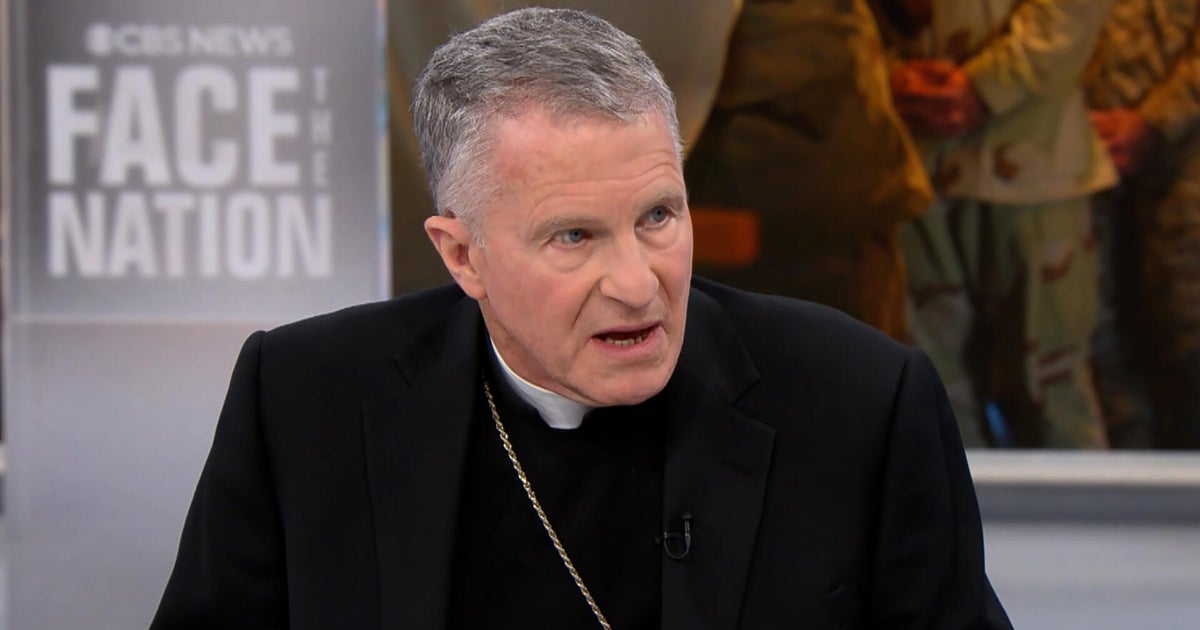
The following is the full text of an interview with Archbishop Timothy Broglio of the Diocese of Military Services in the USA, part of which will be broadcast on “Face the Nation with Margaret Brennan” on April 5, 2026. This interview was recorded on April 2, 2026.
ED O’KEEFE: We now turn to Archbishop Timothy Broglio of the Archdiocese for the Military Services USA, who oversees more than 200 Catholic chaplains who serve as chaplains in the US military. Thank you so much for being here. We really appreciate it, and part of the reason we wanted to hear from you is that your ministry is unique in the sense that you’re not looking at a local area or any physical church, you’re actually serving on bases and on battlefields. And so given the activities that are going on right now in the Middle East, the Caribbean, other parts of the world, I’m curious, what is your spiritual guidance for a service member who is going to seek it?
Archbishop TIMOTHY BROGLIO: Well, I’m very grateful for the opportunity, and it’s- it varies depending on where the person is. We are dealing with the situation in the Middle East now, for example, where the clergy are still there, but many of their dependents have been moved to Europe or sent back to the United States. So they found themselves in a situation where the faithful who served them were gone or in hotels. So that changes the whole truth. And then there are others, of course, who are with the imported forces. And then, their service – the service, in a sense, is a little more – more casual, but still challenging because of the situation.
ED O’KEEFE: Given that you’re a priest who serves military people, I think a lot of your work, a lot of the focus, is built around St. Augustine and the idea of just war, or when war is appropriate, the idea that it’s only waged as a necessity and to achieve peace, and more broadly, perhaps, that the response is limited.
ARCHBISHOP BROGLIO: All right.
ED O’KEEFE: That’s clarifying deep teachings, but really, that’s the root of it. I know that after the president, for example, threatened to take Greenland by force, you said in an interview, it does not seem acceptable to attack a friendly nation, and that such a statement tarnishes the image of the United States. He said it would be an illegal and immoral order to deliberately kill survivors of a suspected Venezuelan drug boat if they did not pose an immediate lethal threat to our military. So given what’s happening in the Middle East, I’m curious. Is war with Iran justified?
Archbishop BROGLIO: I would think under the reason- under the theory of just war, it’s not that when there was- there was a threat with nuclear weapons, it’s that – it offsets the threat before the- the threat happened- it was actually realized. And I think that when I would–I would associate with Pope Leo, who has been advocating for dialogue. I can also see that you would say, who will you interview? And that, that- that’s a problem. But in the meantime, lives are being lost, there and among our soldiers. So, of course- it’s a concern.
ED O’KEEFE: So if you hear a member of the ministry say, if your teachings, if your guidance is not appropriate, what should I do as a Catholic in the ministry?
ARCHBISHOP BRROGLIO: And that’s – that’s a very good question, because obviously, the way conscientious objection is set up in the United States military, you can’t stand against a certain war or a certain action. You can only object, I am against war. So I would think it depends on where you are in the chain of command. Obviously, you know, a Marine that’s given an order, he’s not really in a position, to resist that order. I mean, he should obey unless it is, unless it is clearly immoral. And then maybe he would have to talk to his, you know, his instructor, his chain of command. The question would be, do you know if the generals or the admirals would have a say maybe, can we look at this another way? But as I talked to some of them again, they are in the same situation – in the same problem. So I guess my advice would be to do as little damage as possible- as much as possible, and try to save innocent lives.
ED O’KEEFE: And you approach this from a moral point of view. This is not a collective thing. This is not your ideological or geopolitical. You are a moral leader, so it is obvious that a person in ministry facing this will seek guidance from you and your fellow pastors. How many times have they come to talk about how to ask for forgiveness, maybe for being a part of this?
ARCHBISHOP BROGLIO: Actually that’s something we’ve worked a lot on as an archdiocese, the whole question of moral harm. So, even if you’re obeying a legal order, but you have to kill someone, that’s going to leave some traces, you know, in your heart or–or in your soul. And so when we try to provide facilities and to–to help–to people in that situation, to try to help them heal in those–in those situations. And that is not a question of making a judgment. It’s just a question of treating the person who finds himself, or herself, in that situation.
ED O’KEEFE: Yes, you apparently, and- you- and your brother priests in the Pentagon taking orders apparently through the military chain of command. There has been a lot of discussion in recent weeks, separate from the war itself, about the speech of the Secretary of Defense, Pete Hegseth, who openly asks Jesus repeatedly when he talks about the war with Iran in particular, and publicly prays in the press room of the Pentagon for blessings from the members of the American service. It is clearly his right to pray in front of people however he sees fit. But what do you do with that kind of focus and–kind of trying to make this war something that Jesus might condone?
ARCHBISHOP BROGLIO: It’s- it’s a little bit problematic in the sense that the Lord Jesus certainly brought a message of- a message of peace and- again, I think war is always a last resort. Now, you know, they might have had an experience that made them think that was the only choice they had. I’m not making a judgment about that because I don’t really know, but I think it’s hard to make this war, you know, like something that the Lord can support.
ED O’KEEFE: And that’s something the Pope suggested, right? Not–not commenting on the secretary, but commenting on the war in general, that this idea of–that, you know, if you pray for the success of the war, what is he said recently, he said, “God does not listen to the prayers of those who fight the war, but He rejects them.” That would seem to put a lot of what’s going on right now into conflict.
ARCHBISHOP BROGLIO: Indeed – it would be so. And I’m just going back to Paul VI, who made very few trips outside of Italy, but when he came to the UN he made that amazing appeal, which I saw live on television – as a small child. You know, j’aime pas la guerre, j’aime pas la guerre, I will not fight again, I will not fight again. And–and yet, that was 1965, I think. Now, many years later, we are still in this situation. So I think- I think I’ll be- I think Pope Leo would really support you in saying that, you know, we have to find a situation where men and women can sit down and–and– and find ways of peace.
ED O’KEEFE: In our remaining times, it is clear that you serve mainly members of the Catholic service, but this is a holy time, Easter continues, Ramadan has just ended, and finally on the battlefield, it does not matter to your brother’s priests, whether they are Catholic or Protestant or Jewish, what is the dialogue of religions like these days, especially during war?
Archbishop BROGLIO: I think – it’s very healthy in the sense that there is a real desire to work together. Actually, I know many rabbis in services, because we often go at the same time – at the same time. Ours, Christmas and Easter. For them, Passover and Hanukkah. And they are few in number, so I get to meet them, but there is a real spirit of cooperation, and there is a desire to help the work of the pastors. And I think that’s a very healthy thing.
ED O’KEEFE: Well, thank you for being here this Easter weekend, and thank you, obviously, for your service, not only to the country, but to the faith. We appreciate spending time with us.
Archbishop BRROGLIO: Thank you. Thank you so much for the opportunity.